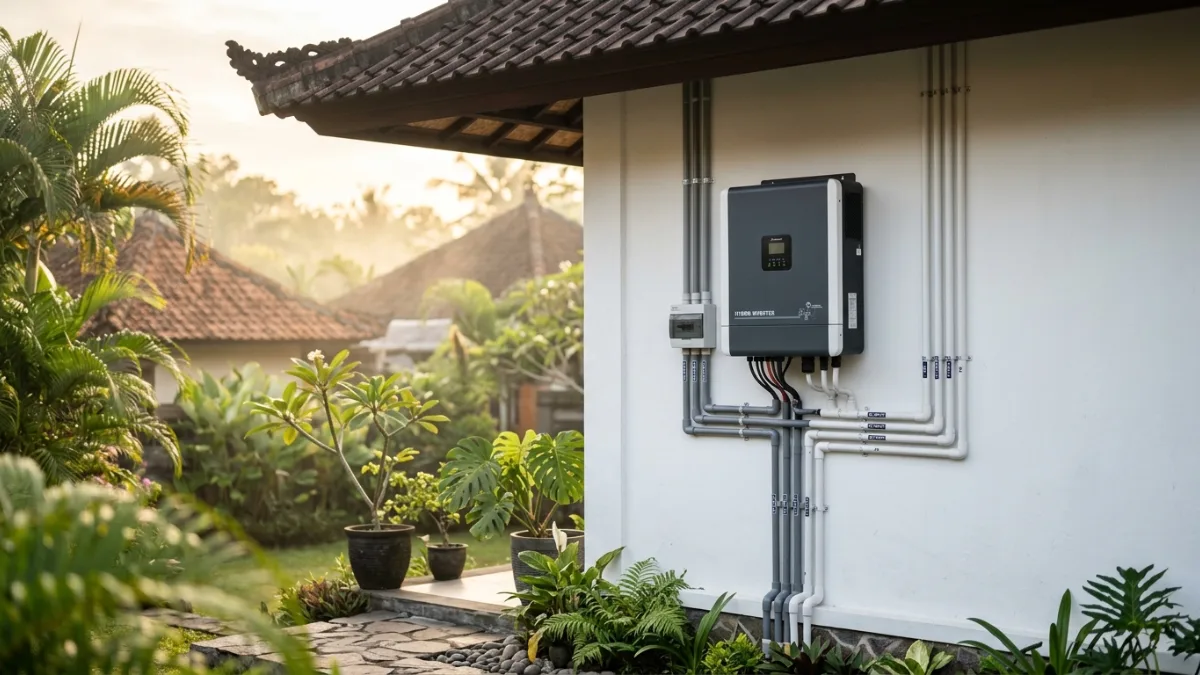
The inverter is the brain of a hybrid solar system. It converts DC from panels to AC for your home, charges the battery if you have one, and switches between solar, battery, and grid based on priority. Your inverter choice affects system output, operational stability, monitoring convenience, and replacement cost 8 to 10 years out.
The three brands that come up most in installer packages for Indonesian homes in 2026 are Growatt, Luxpower, and Deye. All three are tier-2 globally but mature in Indonesia's residential market. The fair question: do they actually differ in practice, or is it just installer preference? This article breaks them down by capacity sweet spot, after-sales experience, monitoring app, and pricing.
Reading this in Bahasa Indonesia? Switch to the Indonesian version.
TL;DR
- Growatt sweet spot: sub-3 kW small hybrid, widest Indonesia distribution.
- Luxpower sweet spot: 3 to 5 kW mid-tier hybrid, solid build quality, clean app.
- Deye sweet spot: 5 kW+ including 3-phase and parallel expansion, most flexible.
- Retail pricing differs by 10 to 20% across brands at the same class. Not decisive on its own.
- The factors that matter more: after-sales network in your city, compatibility with your battery brand, monitoring app you're comfortable using.
How to compare hybrid inverter brands
Hybrid inverters at the same tier have converging core specs: peak efficiency 96 to 98%, 2 to 3 string MPPT, surge capacity 1.2 to 1.5x rated, grid-to-battery switching under 10ms (anti-blackout). The differences in these numbers are usually small for residential home use.
The five dimensions that actually matter for your decision:
1. Brand capacity sweet spot. Each brand has a line that's most mature in a particular capacity range. Brand A at 3 kW isn't necessarily as mature as brand A at 8 kW. Pick the brand whose sweet spot matches your home's inverter sizing.
2. After-sales network in your city. An inverter that fails in year 3 or 5 needs an accessible service center. Check which brand has distributors and technicians in your city, not just in Jakarta.
3. Monitoring app quality. You'll be checking the system on your phone at least monthly. A stable app with a clean UI matters for daily user experience.
4. Battery compatibility. Hybrid inverters communicate with the battery via a BMS protocol (CAN bus or RS485). Confirm your battery brand (HinaESS, Pylontech, BYD) is on your chosen inverter's compatibility list.
5. Parallel expansion and 3-phase support. If you plan to expand to 10+ kWp or already have a 3-phase PLN connection, the brands that flex well for parallel and 3-phase narrow to Deye and the upper Luxpower line.
Check your home's inverter sizing with the calculator.
Growatt: widest distribution, sub-3 kW sweet spot
Growatt is one of the pioneer hybrid inverter brands in Indonesian residential, with widespread distribution since 2018 to 2020. The lines you'll see most in installer packages: SPF series (off-grid + low-voltage battery) and SPH series (hybrid + high-voltage battery + grid-tie).
Typical SPH 3000 spec: 3 kW AC output, MPPT range 100 to 450V, 2 string input, peak efficiency 97.6%, 6 kVA surge, 5-year warranty.
Practical strengths:
- Widest distribution across Java-Bali and parts of eastern Indonesia. Service centers are accessible in most tier-2 cities (Surabaya, Bandung, Yogyakarta, Makassar, Medan).
- Competitive retail, sweet spot value at 2 to 3 kW. For 1300 to 2200 VA PLN connections with a small hybrid, Growatt is usually the most economical pick.
- ShinePhone app is mature and stable; the basics (real-time power, daily / monthly / yearly kWh, fault alarms) are all there.
- Wide battery compatibility: HinaESS, Pylontech, BYD, Dyness, Voltacon are all on the compatibility list.
Trade-offs:
- ShinePhone UI feels dated (2018 era), and navigation can be awkward compared to newer apps like SOLARMAN or SmartLux.
- The 5 kW+ sweet spot is less dominant compared to Deye. The SPH 10K+ exists, but 3-phase and parallel support is more advanced on the commercial lines (MOD, MAX), not the residential SPH.
- Some older units have thermal issues in Indonesia's tropical environment (auto-derate output above 35 Celsius). The 2024+ revisions improved this, but a ventilated install location is important.
When Growatt makes sense: you want a sub-3 kW hybrid for a 1300 to 2200 VA PLN home, you prioritize accessible after-sales in your city (especially tier-2), and you want sweet-spot tier-2 pricing.
Luxpower: solid build quality, 3 to 5 kW sweet spot
Luxpower Tek is a Chinese brand focused on residential hybrid since 2018, with mature presence in Indonesia since 2021 to 2022. The lines you'll see most: LXP-LB series (low-voltage battery, single-phase residential) and LXP-3PH (3-phase residential).
Typical LXP-LB 5K spec: 5 kW AC output, MPPT range 90 to 450V, 2 string input, peak efficiency 97.5%, 7.5 kVA surge, 5-year warranty.
Practical strengths:
- Solid build quality with a strong reliability reputation among owner forums and installer feedback. Better heat management than many tier-2 alternatives in Indonesia's tropics.
- Sweet spot at 3 to 5 kW for residential PLN 2200 to 3500 VA. This range is dominant for Indonesian middle-class homes planning hybrid.
- SmartLux app has a clean UI, simple navigation, and accessible real-time and historical data. A good fit for owners who prefer a minimal interface.
- Wide battery compatibility (HinaESS, Pylontech, BYD), with both CAN bus and RS485 protocol support.
Trade-offs:
- Distribution isn't as wide as Growatt and Deye. Service centers in tier-3 cities sometimes have to route through more distant importers.
- Product range is narrower than Deye (Luxpower focuses on residential; Deye also serves C&I). For homes it doesn't matter, but for plans to grow into a larger micro-grid, Deye has more room.
- SmartLux app has fewer features than SOLARMAN (Deye). Plenty for a single-system owner; light for a power user wanting rich analytics.
When Luxpower makes sense: you want a 3 to 5 kW hybrid for a 2200 to 3500 VA PLN home, you prioritize build quality and long-term reliability, you're OK with distribution narrower than Growatt, and you like a clean app interface without bloat.
Deye: 5 kW+ sweet spot with 3-phase and parallel expansion
Deye New Energy is a global brand that entered Indonesia's residential market around 2020 to 2022, now one of the fastest-growing hybrid brands here. The lines you'll see most: Sun-5K-SG / Sun-8K-SG / Sun-10K-SG (single-phase and 3-phase variants) and SUN-12K through SUN-50K for commercial.
Typical Sun-8K-SG04LP1-EU spec: 8 kW AC output single-phase, MPPT range 125 to 500V, 2 string input, peak efficiency 97.6%, 12 kVA surge, 5-year warranty (with 10-year extension via authorized distributor).
Practical strengths:
- Most mature 5 kW+ sweet spot. The Sun 5K / 8K / 10K line dominates installer packages for 3500 to 5500 VA PLN homes and larger.
- Most flexible parallel expansion: 2 to 6 Deye inverters can run in native parallel on certain lines, scaling to 30+ kW for larger homes or small commercial.
- Strong 3-phase support on the SG04LP3-EU line (native 3-phase), relevant for homes with 3-phase PLN or planning a higher-power upgrade.
- SOLARMAN app has the richest feature set (multi-inverter, multi-site, rich alarms, scheduled charging, CSV historical export).
- Indonesian distribution growing fast, now accessible across most tier-2 cities.
Trade-offs:
- For sub-3 kW (1300 VA PLN), Deye has lines but is less price-competitive vs Growatt SPF/SPH 3000. The Deye sweet spot starts at 5 kW+.
- Tier-3 city service centers are still building out, sometimes routed through Surabaya / Jakarta hubs. Confirm local availability before committing.
- The SOLARMAN app's feature richness means a steeper learning curve for a casual user. Power users appreciate it; casual users sometimes feel overwhelmed.
When Deye makes sense: you want a 5 kW+ hybrid for a 3500 to 5500 VA PLN home or larger, you're planning expansion to parallel or 3-phase, you prioritize a feature-rich app, and your installer is comfortable with the Sun series.
Decision matrix: which one based on your case
Rather than picking a winner, frame it per scenario:
Home with PLN 1300 to 2200 VA, small hybrid 2 to 3 kW, value plus accessible after-sales: Growatt SPH 2000 / 3000 is usually the sweet spot. Wide distribution, competitive pricing, mature service centers in most cities.
Home with PLN 2200 to 3500 VA, mid-tier hybrid 3 to 5 kW, reliability plus clean app: Luxpower LXP-LB 5K makes sense. Solid build reputation, clean app, competitive pricing in this range. OK with narrower distribution.
Home with PLN 3500 to 5500 VA, hybrid 5 to 8 kW, planning expansion or 3-phase: Deye Sun-5K / 8K / 10K-SG is the sweet spot. Flexible parallel expansion, native 3-phase support, feature-rich app. Competitive pricing in the 5 kW+ class.
Home with PLN 5500+ VA or larger, planning parallel multi-inverter setups: Deye dominates. Native parallel support and 3-phase are the most mature. Upper Luxpower LXP also supports it but the line is more limited.
If your installer pushes one brand by default: ask why. Credible installers usually evaluate trade-offs based on distribution, distributor relationship, and brand handling experience. An installer who only sells one brand without flexibility is a warning sign.
If a quote is too cheap: watch out for rebadged or second-grade inverters. Tier-2 inverter retail typically runs Rp 4 to 7 million per kW. If a quote shows a 5 kW inverter under Rp 18 million, verify the brand and exact model in the manufacturer datasheet.
Honest take
These three brands are all technically mature enough for residential Indonesia. For a single-inverter 5 to 8 kW system on typical residential use, the cumulative output difference between them over 10 years is probably 1 to 3%. That's small compared to factors like panel shading, routine cleaning, correct cable sizing, or a ventilated install location.
Pick the inverter after the capacity is sized and a credible installer is surveyed. If you're at the brand-pick stage and still unsure, ask the installer: which brand do they install most in your city, and when did they last handle a warranty claim for it. The real answer opens a more useful conversation than a spec-sheet comparison.
Frequently asked questions
All three have residential hybrid lines (solar panels + battery + grid). Growatt SPF and SPH series, Luxpower LXP series, Deye Sun hybrid series. Each brand also sells grid-tied-only lines (no battery support), so make sure your installer specifies the hybrid model if you plan to add a battery.