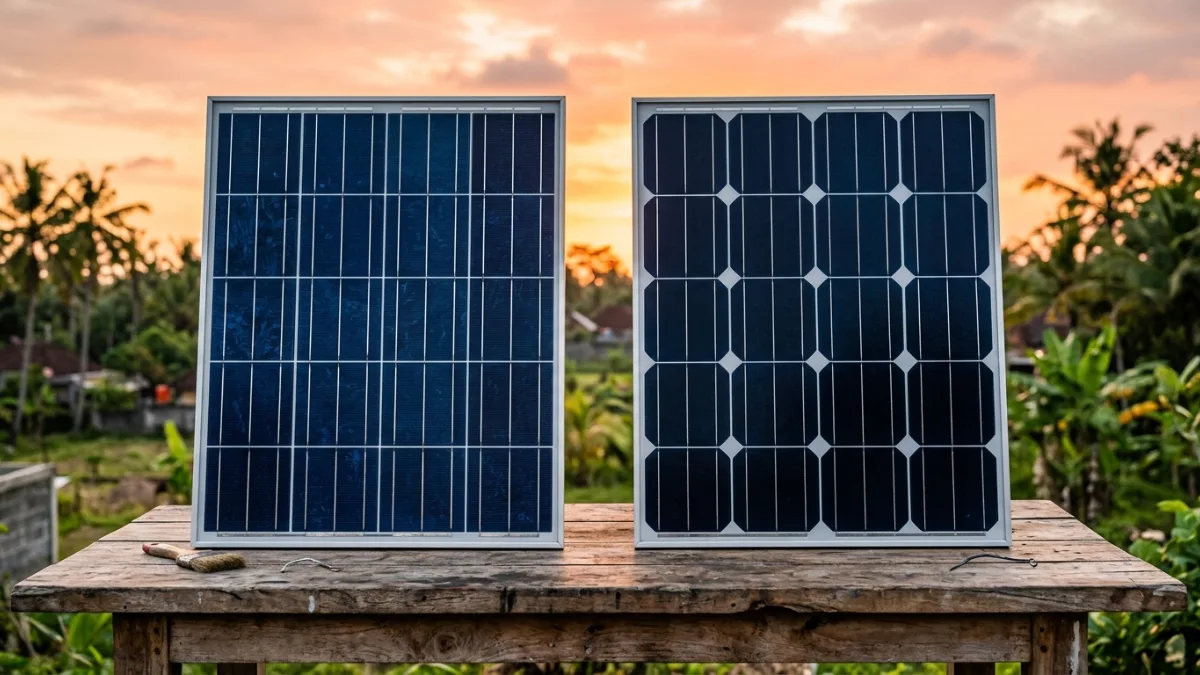
When you compare quotes from two or three installers, panel brand is one of the recurring items: Jinko Tiger Neo, LONGi HiMO, Canadian HiKu. All three are Bloomberg Tier-1, all are pitched as "premium quality" by their respective installers, and retail prices differ only slightly. The fair question: does it actually matter for you as a homeowner, or is it just marketing?
Honestly, the electrical spec differences are small. What matters more for your decision: which brand your installer is comfortable handling, which local service center is accessible for claims 10 years out, and whether the module dimensions fit your roof layout. This article breaks down all three from the angles that matter for an Indonesian home, not generic ranking from a spec sheet.
Reading this in Bahasa Indonesia? Switch to the Indonesian version.
TL;DR
- Three tier-1 brands, similar core specs. Differences are in distribution, inverter ecosystem, and module dimensions.
- Jinko Tiger Neo: most installer packages in Java-Bali, competitive pricing, TOPCon-dominant.
- LONGi HiMO 6/7: highest efficiency in class, ideal for limited roof space.
- Canadian HiKu: most mature local distributor, sweet-spot value for residential packages.
- Retail spreads 5 to 10% across brands. For a 5 kWp system that's Rp 2 to 5 million. Not decisive on its own.
How to compare tier-1 solar panel brands
Before going brand by brand, level-set the framework. Tier-1 panels have converging baseline specs: module efficiency 21 to 23%, linear power warranty 25 to 30 years to 80 to 87%, product warranty 12 years, temperature coefficient around -0.3% per Celsius. Differences in these numbers are usually small, and for residential use in Indonesia, not decisive.
The five dimensions that matter more for your decision:
1. Module dimensions and wattage. Modern modules in 2024 to 2026 range 540 to 620 Wp at roughly 2.3 m by 1.1 m. A 10 cm difference in length can mean one extra panel fits or doesn't fit on your roof. Check the specific brand's datasheet.
2. Service network in Indonesia. Brands with official local distributors operating 5+ years handle claims more smoothly. Brands with rotating importers have less stable service centers.
3. Inverter brand pairings. Tier-1 panels are technically compatible with all major inverters, but certain pairings are more common (Jinko + Sungrow in Java packages, Canadian + Goodwe in Surabaya).
4. Price per Wp. Range Rp 2,500 to 3,200 per Wp retail in 2026. Premium brands run 10% above, value brands 10% below, all within tier-1.
5. Bifacial or mono-facial. Bifacial fits roofs with high albedo (white deck, flat surface). Mono-facial is enough for standard pitched tile roofs.
Check your home's panel sizing and price with the calculator.
Jinko Solar: widest distribution in Indonesian residential
Jinko Solar is one of the largest global producers as of 2026, with annual production output in the tens of GW. In Indonesian residential, the line you'll see most is Tiger Neo with TOPCon cell technology (Tunnel Oxide Passivated Contact, an n-type cell with slightly higher efficiency than PERC).
Typical Tiger Neo 580W spec: 22.5% efficiency, dimensions 2.38 x 1.13 m, temperature coefficient -0.3% per Celsius, 12-year product warranty + 30-year linear power warranty to 87.4%.
Practical strengths:
- Widest distribution across Java-Bali via several official importers and local distributors. Stock rarely runs dry in mid-tier installer packages.
- Competitive pricing (often 5 to 10% below LONGi premium at equivalent wattage).
- TOPCon technology adoption is fast across the product line, so the latest modules are usually available.
- Monitoring ecosystem often pairs with Sungrow iSolarCloud or Huawei FusionSolar.
Trade-offs:
- Service centers rotate among importers; for warranty claims 10 years out, there's some risk that procedures shift as importers change.
- Very large global brand; customer service can feel less personal if you need a specific escalation.
When Jinko makes sense: you want a mid-tier residential package in Java-Bali, your installer is comfortable handling Jinko, your roof has reasonable space (the 2.38 m dimension isn't the smallest in class), and you prioritize availability and competitive pricing.
LONGi Solar: highest efficiency in class
LONGi Solar focuses on monocrystalline cell technology and was one of the early PERC pioneers in the 2010s. As of 2026, the residential line you'll see most in Indonesia is HiMO 6 and HiMO 7, with HPBC (Hybrid Passivated Back Contact) and TOPCon technology in the latest variants.
Typical HiMO 7 580W spec: 23% efficiency (slightly above Jinko Tiger Neo), dimensions 2.38 x 1.13 m, temperature coefficient -0.29% per Celsius, 12-year product warranty + 30-year linear power warranty to 87.4%.
Practical strengths:
- Highest efficiency in class with a thin margin (0.2 to 0.5% above Jinko and Canadian at equivalent wattage). For roofs with limited space, this can mean one extra panel fits or higher total kWp at the same footprint.
- Strong engineering reputation, often picked for mid-premium projects that prioritize output per square meter.
- Official distribution exists in Indonesia, although the service network is thinner than Canadian.
Trade-offs:
- Retail pricing 5 to 10% above Jinko at equivalent wattage. For a 5 kWp system, that's a Rp 3 to 5 million delta.
- Fewer local service center options than Canadian; warranty claims have to route through specific distributors.
- The newest panels sometimes lag in Indonesian installer packages (new lines launch in China first, reach Indonesia 6 to 12 months later).
When LONGi makes sense: your roof space is limited (cluster house, split-orientation roof, need to maximize output per square meter), you're OK with a 5 to 10% premium, and your installer has experience handling this brand including warranty claims.
Canadian Solar: most mature local distributor
Canadian Solar (HQ Toronto, manufacturing in China) has been operating in Indonesia since the early 2010s. The residential line you'll see most is HiKu series with PERC and TOPCon technology in the latest variants.
Typical HiKu 6 575W spec: 22.3% efficiency, dimensions 2.38 x 1.13 m, temperature coefficient -0.34% per Celsius, 12-year product warranty + 25-year linear power warranty to 84.8% (slightly more conservative than Jinko / LONGi at 87.4%).
Practical strengths:
- Most mature official local distributor in Indonesia (Jakarta and Surabaya hubs operating 10+ years). Smoothest warranty claims by track record.
- Responsive customer service, technical questions go directly through the distributor.
- Package ecosystem with Goodwe or Sungrow often hits the sweet-spot value for installer packages.
- Retail pricing usually 5% below LONGi, on par or slightly above Jinko.
Trade-offs:
- Linear power warranty to 84.8% at year 25 (vs 87.4% for Jinko / LONGi). For a 5 kWp system at year 25, that's about 4.24 kWp output vs 4.37 kWp. Real but not huge.
- Module efficiency is slightly below the latest LONGi (22.3 vs 23%). Doesn't matter for spacious roofs, may matter for limited ones.
When Canadian makes sense: you prioritize a clear warranty claim path through a local distributor (long-term family home, plan to live there 20+ years), your installer has a mature distribution relationship, and you want sweet-spot tier-1 pricing (not the cheapest, not the most premium).
Decision matrix: which one based on your case
Rather than picking a winner, frame it per scenario:
If your roof space is limited (cluster house, split-orientation roof, under 30 sqm usable): LONGi HiMO 7 makes sense because the highest efficiency maximizes output per square meter. The 5 to 10% premium is comparable to adding 0.5 to 1 kWp of capacity in the same footprint.
If your roof is spacious + value priority + Java-Bali installer package: Jinko Tiger Neo is usually the sweet spot. Wide distribution, competitive pricing, your installer in Java-Bali probably already handles it. The thin efficiency edge vs LONGi (0.5%) isn't decisive on a spacious roof.
If you plan to live there 20+ years + prioritize a clear warranty claim path: Canadian HiKu via the local Jakarta or Surabaya distributor makes sense. Linear power warranty is slightly more conservative, but the service network is the most mature in Indonesia. Small premium over Jinko, value matches.
If your installer offers only one brand: ask why. Credible installers usually evaluate trade-offs and have specific recommendations per case. An installer who only sells one brand without explaining trade-offs is a warning sign.
If a quote shows tier-2 as the default option: evaluate that tier-2's service network in Indonesia. Tier-2 can be OK if the brand has been operating 5+ years here with a verifiable local distributor. A tier-2 with seasonal importers is a real risk for warranty claims 10 years out.
Honest take
These three tier-1 brands are far more similar than different. For residential use in Indonesia over 25 years, the cumulative output difference between them is probably 2 to 5%, which is small compared to factors like mounting quality, routine panel cleaning, correct inverter sizing, or roof shading.
Picking the panel brand is the last variable, not the first. If you're still figuring out kWp sizing, haven't surveyed the roof, or haven't compared two or three installer quotes, focus there first. Brand can be decided at the quote-review stage, after a credible installer gives you a full breakdown with two or three brand options for consideration.
If you're at the brand-pick stage and still unsure, ask the installer: which brand do they install most in your city, and why. The answer usually opens a more useful conversation than a spec-sheet comparison.
Frequently asked questions
Yes, all three are consistently on Bloomberg NEF's Tier-1 list quarter after quarter. That means the manufacturer has project financing from independent banks, production scale of 1+ GW per year, and a solid financial track record. For a homeowner, the relevance: high probability they'll still exist and honor a 25-year warranty.